What is Perigon?
Perigon is a news aggregator platform that goes beyond collecting headlines. It ingests over one million articles daily from 200,000+ global sources, applies proprietary AI to extract entities, detect events, classify topics, analyze sentiment, and cluster related stories — then delivers that structured intelligence through APIs, a real-time monitoring layer, and pre-built datasets. Unlike basic news aggregators that deliver raw article feeds, Perigon functions as a context engine: it connects the dots across the global information landscape, revealing the complete narrative behind any event, company, person, or topic.
Media monitoring professionals, brand teams, sales and revenue teams, risk analysts, competitive intelligence teams, developers, and enterprise organizations use Perigon to replace manual news scanning with always-on, structured intelligence that integrates directly into the tools and workflows they already use.
Features & Benefits
- Real-time news search – Search and filter the full Perigon index using keyword, boolean, vector, and semantic search across 200,000+ sources. Filter by topic, sentiment, location, source, entity, date, and taxonomy to surface exactly the news that matters.
- Story clustering and trend detection – AI automatically groups related articles into coherent story threads. Follow how narratives develop across multiple sources over time without reading every article individually.
- Company news monitoring – Track every news mention of any organization across all indexed sources. Monitor sentiment trends, identify coverage spikes, follow developing stories, and detect events such as mergers, lawsuits, executive changes, funding rounds, and product issues in real time.
- Individual and influencer news tracking – Monitor news coverage of specific people including executives, public figures, investors, journalists, and influencers across thousands of global publications. A confirmed use case involves a major influencer agency using Perigon to monitor the reputations of 14,000+ influencers, identifying legal issues, brand conflicts, and controversies in real time before they escalate.
- Journalist database – Access structured data on journalists organized by beat, publication, coverage history, and topic focus for targeted media outreach and press monitoring.
- Topic and taxonomy search – Browse and filter news by thousands of topic classifications across industries, sectors, and regions. Supports multi-dimensional research across overlapping topics without keyword guesswork.
- AI summaries – Receive AI-generated summaries for individual articles and search results to accelerate media monitoring workflows without reading every source in full.
- Sentiment analysis – Filter and analyze news by sentiment score to identify positive, negative, or neutral coverage trends for any entity, topic, market, or geographic region over time.
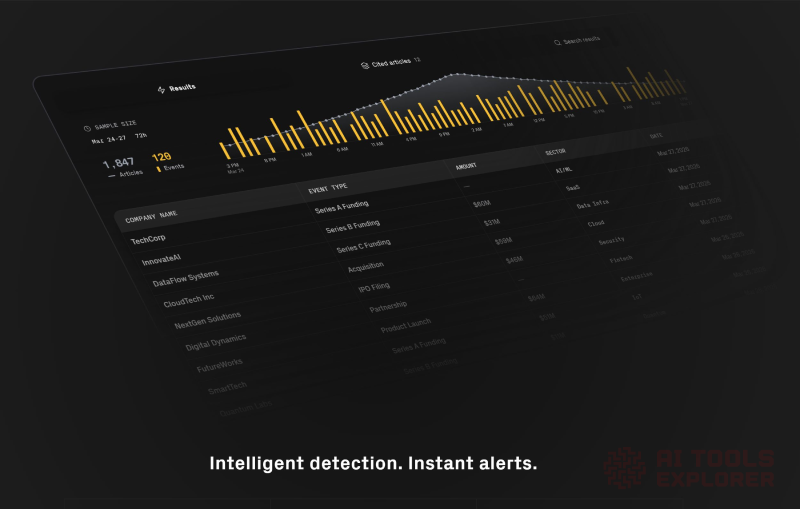
- Structured event monitoring (Signals) – Signals replaces keyword alert systems with structured event intelligence. Instead of receiving a stream of raw articles every time a keyword appears, teams define the structure of the data they want to capture: event type such as lawsuit, funding round, executive change, product issue, or regulatory action; company or entity involved; geography; severity level; and source citations. When new information appears, Signals determines whether it represents a new event and records it in that structure. Multiple articles covering the same development are automatically deduplicated into a single event record. New events are typically detected within six minutes of publication. Structured outputs can be delivered via email, Slack, Microsoft Teams, HubSpot, Salesforce, Notion, Google Docs, or webhooks into internal dashboards and downstream systems.
- Custom data schema definition – Define exactly which fields a Signal should capture, including field types such as text, boolean, numeric, date, and category. Write rules that guide how information is captured per field. Shape the output data around the specific use case rather than working with a fixed format.
- News datasets – Access pre-structured, ready-to-use news datasets organized by category: business, public markets, consumer, cybersecurity, AI, entertainment, medical, and more. Updated continuously and available for download or API delivery.
- Historical news archive – Search and retrieve up to 10+ years of historical news data on Business plans. Supports forensic research, long-term trend analysis, competitive benchmarking, and AI model training.
- Developer API and integrations – Access all Perigon data programmatically via REST APIs with Python, TypeScript, and Go SDKs. Connect into AI agent workflows via the Model Context Protocol server. Integrate with n8n for workflow automation and LangChain for AI pipeline development.
- Wikipedia API – Search Wikipedia articles with semantic vector search for contextual background on entities, topics, and events alongside real-time news coverage.
Real-World Applications
Brand reputation and media monitoring teams can use Perigon as a news aggregator platform to track every mention of their company, products, executives, and brand terms across global news in real time. Sentiment scoring and story clustering show not just what is being written but how the narrative is developing — whether a single critical article is an outlier or part of a growing pattern. PR teams can respond to emerging issues within minutes rather than discovering them after they have already spread. A confirmed use case: the world’s largest influencer agency uses Perigon to continuously monitor the reputations of 14,000+ influencers simultaneously, surfacing legal issues, brand conflicts, and public controversies in real time without manual scanning. The same news aggregator platform capability applies to any organization monitoring a large network of people, brands, or locations at scale.
Sales and revenue intelligence teams can use Perigon’s Signals to convert news events into CRM-ready buying intent signals without manual research. Signals detects funding announcements, executive hires, product launches, regulatory actions, and other commercial triggers from news coverage and routes structured event data directly into HubSpot or Salesforce records. Sales reps receive relevant account intelligence automatically — the news aggregator platform does the research, they do the outreach. This eliminates hours of manual prospecting and ensures that high-signal news events reach the right person in the right system within minutes of publication.
Market intelligence and competitive research teams can use Perigon to run continuous competitive intelligence across an entire industry without building internal monitoring infrastructure. Signals structured event detection captures not just article volume but the specific event type — merger, litigation, product recall, regulatory action, leadership change — giving analysts business intelligence that is already categorized and ready to route into reporting tools, dashboards, or team briefings. A government contractor use case involves using Perigon to monitor public sentiment around immigration across US media, helping optimize the timing of communications based on how news coverage of the topic is trending across regional and national outlets.
Risk and compliance teams in financial services, government contracting, and enterprise security can use Perigon for real-time risk intelligence at scale. Monitoring news coverage of geopolitical developments, regulatory changes, sanctions, and entity-level events across global sources provides early warning signals before those developments impact operations. The six-minute average detection time, combined with sentiment analysis, automatic deduplication, and 10+ years of historical archive, supports both live risk monitoring and retrospective compliance analysis. The structured event output means risk signals arrive already categorized and prioritized, not buried in a feed of raw articles.
Developers and data teams building news-powered applications, AI pipelines, or internal intelligence tools can use Perigon’s APIs as the data layer without managing scraping, deduplication, or enrichment infrastructure. The MCP server integration allows news intelligence to flow directly into Claude, n8n, LangChain, and other AI agent frameworks, enabling autonomous monitoring and analysis workflows at scale. Pre-built SDKs for Python, TypeScript, and Go reduce integration time, and the historical archive supports training and fine-tuning AI models on structured, real-world news data.