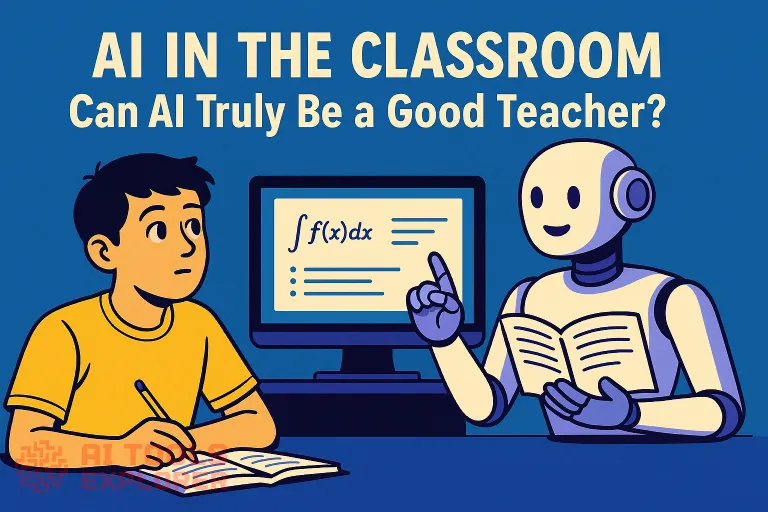
Imagine this: It’s 2 AM, and you’re struggling with calculus homework. Your human teacher is fast asleep, but your AI tutor responds instantly: “Let’s break down this integral step by step.” This is the reality for millions of learners today. As AI education tools explode in popularity—from language apps to math solvers—we face a critical question: Can algorithms ever match the magic of human teaching? Let’s explore the promise and pitfalls of silicon instructors.
The Rise of the Digital Tutor
When 14-year-old Maria started falling behind in algebra, her parents couldn’t afford a tutor. Then they discovered Khanmigo, Khan Academy’s AI teaching assistant. Within weeks, Maria was solving equations she’d found impossible before. “It feels like it reads my mind,” she says. “When I get stuck, it doesn’t judge me—it just tries a new approach.”
Stories like Maria’s are becoming common. Schools from California to Kenya are experimenting with AI teaching platforms, reporting:
- 30% faster concept mastery in STEM subjects
- 45% reduction in homework anxiety
- 60% more practice time per student
But behind these impressive stats lies a complex reality. What makes teaching effective isn’t just information delivery—it’s that spark of connection when a concept clicks.
What Human Teachers Do That Machines Can’t
Mrs. Davies’ high school biology class erupts in laughter as she impersonates a dancing chromosome. Her students won’t forget mitosis after that performance. This highlights the irreplaceable core of great teaching:
The Empathy Factor
Human teachers build “learning relationships”—they notice when a student’s usually bright eyes go dull, sense nervousness before presentations, and share personal stories that make abstract concepts tangible. When Jessica failed her chemistry midterm, her teacher Ms. Chen pulled her aside: “I bombed this too in college. Let me show you how I turned it around.” That moment of vulnerability became Jessica’s turning point.
Nurturing Critical Thinkers
While AI can explain the causes of World War II, only humans can facilitate the messy, passionate debates where real critical thinking grows. Mr. Thompson’s history students don’t just memorize dates—they role-play Versailles Treaty negotiations, arguing ethics and consequences. This develops skills no algorithm can teach: persuasion, empathy, and ethical reasoning.
Where AI Teachers Shine Brightest
The Personalization Revolution
Traditional classrooms often teach to the middle, leaving both struggling and advanced students behind. AI shatters this limitation through adaptive learning technology. Consider these breakthroughs:
- Duolingo’s algorithms track 157 data points per learner, adjusting exercises in real-time
- Century Tech’s neuroscience-backed platform identifies knowledge gaps before students realize they exist
- Mathia by Carnegie Learning provides customized hints like a personal coach
For 10-year-old Arjun in rural India, this meant finally conquering fractions. His village school had one teacher for 60 students. “The AI tutor showed me animated pizza slices until I understood,” he grins. “Now math is my favorite subject!”
Instant Feedback: The Accelerator
Waiting days for graded papers is becoming obsolete. AI’s real-time feedback creates powerful learning loops:
- Attempt a physics problem
- Get immediate error analysis
- Try corrected approach
- Master concept in minutes, not weeks
Harvard studies show this approach reduces learning time by 40% compared to traditional methods. Language learners particularly benefit—apps like ELSA Speak correct pronunciation before bad habits form.
The Troubling Gaps in AI Education
📉 The Motivation Problem
Initial enthusiasm for AI tutors often crashes against a hard reality: without human connection, sustained engagement falters. Studies reveal that while AI can deliver short-term gains, students struggle to maintain motivation. In one experiment, students using unrestricted ChatGPT for math help initially scored 48% higher on practice problems—but then performed 17% worse than peers on follow-up tests without AI. Why? Over one-third of their AI interactions were simply “What’s the answer?” requests, bypassing true learning (source). As education researcher Charlie Gedeon observes: “Relationship building is critical for student motivation—and personalized content alone can’t replace it” (source). This explains why students like fifteen-year-old Liam eventually disengage: “When I finally ‘get it,’ there’s no high-five. I just click ‘next problem.'”
🎨 Creativity’s Limits
AI falters profoundly in nuanced interpretation and meaning-making. When analyzing Maya Angelou’s poetry, AI might offer technically accurate analysis but misses the human connections—like Carlos relating verses to his abuela’s immigration story. Research confirms AI struggles with:
- Understanding cultural/historical context in literature
- Generating truly original ideas (not just remixing existing ones)
- Recognizing humor or emotional subtext
These limitations stem from AI’s inability to grasp ambiguity or share lived experiences—the very elements that transform learning from fact-memorization to personal transformation.
Bias and Accuracy Concerns
Real-world implementations reveal alarming equity risks:
Algorithmic discrimination: Grading AIs often penalize non-native English speakers through biased training data (source).
Factual hallucinations: ChatGPT routinely invents historical “facts,” like false Civil War details (source).
Cultural blindness: Facial-analysis AI frequently misreads Asian students’ concentration as confusion 10.
As Stanford’s AI Ethics Lab warns: “These aren’t glitches—they’re systemic equity issues. Algorithms trained on narrow data perpetuate real-world biases” (source).
Striking the Perfect Balance: AI + Humans
The most successful classrooms aren’t choosing sides—they’re integrating both. Here’s how forward-thinking schools are creating hybrid learning environments:
Case Study: Brooklyn’s Tech-Human Blend
The most effective classrooms leverage augmented intelligence—combining AI efficiency with human wisdom. Research shows students using guided AI tutors (like Khanmigo) score 127% higher than control groups while maintaining knowledge retention. Here’s how pioneering schools make it work:
Case Study: The Tech-Human Workflow
At forward-thinking schools like CUNY’s AI-integrated programs (BBK):
| AI Handles | Teachers Focus On |
|---|---|
| Grading routine worksheets | Leading Socratic seminars |
| Generating skill-building drills | Designing project-based learning |
| Providing vocabulary practice | One-on-one mentoring |
| Transcribing lectures | Emotional support & motivation |
This division frees 15+ weekly hours for high-impact teaching while ensuring AI doesn’t overstep its limitations.
Critical Guardrails for Success
To prevent misuse, educators implement:
- “No answers” policies: Custom AI tutors (like MagicSchool’s bots) are programmed to only ask probing questions—never give solutions.
- Bias audits: Regular checks for algorithmic discrimination, especially for SEND/ESL students.
- AI literacy curricula: Teaching students prompt engineering, fact-checking, and ethical use.
The golden rule: AI should always be a “thinking partner”—not an answer machine. When students ask Khanmigo about photosynthesis, it responds: “What do YOU think plants need to grow?” (source).
Your Personal Learning Toolkit
Maximize AI while preserving human connection:
| Learning Goal | Best AI Tool | Human Supplement |
|---|---|---|
| Math Practice | Photomath (scans and explains problems) | Study group for collaborative problem-solving |
| Language Learning | Duolingo Max (roleplay conversations) | Weekly coffee chats with native speakers |
| Writing Skills | Grammarly (grammar/style suggestions) | Writing workshop with peer feedback |
| Test Prep | Quizlet‘s AI tutor (adaptive quizzes) | Teacher-led strategy sessions |
✨ Spotlight: Google Gemini for Students – Your AI Study Superpower
Google Gemini for Students isn’t just another chatbot—it’s a full-scale AI homework helper designed for high school, college, and grad students. Think of it as your 24/7 study buddy that can explain tough concepts, turn notes into quizzes, create videos for projects, and even proofread essays. Powered by Google’s advanced Gemini 2.5 Pro model, it goes far beyond simple Q&A.
🚀 Why Students Love Gemini:
- Upload & Solve: Stuck on math? Snap a worksheet photo → get step-by-step solutions.
- Notes to Study Tools: Turn messy class notes into quizzes, summaries, or podcasts instantly.
- Research Pro: Use Deep Research to analyze papers and build citations in seconds.
- Multimedia Creator: Generate videos, animations, or images for presentations with tools like Veo 3 Fast and Whisk.
- Real-Time Help: Gemini Live lets you talk through problems aloud while screen-sharing.
Real Student Wins:
- High schooler → Uploads calculus homework → Gets explained solutions → Aces test.
- College senior → Converts lecture slides into audio podcasts → Listens during commute.
- Grad researcher → Uses Deep Research to synthesize 20 sources → Exports outline to Google Docs.
💡 Try Gemini for students If You:
- Need homework help (math, science, essays)
- Learn better with audio/video
- Create presentations or animations
- Want research/editing superpowers
→ Access it on: Android, iOS, Chrome, Google Docs, and Drive.
The Future Classroom: What’s Coming Next
Education pioneers are developing astonishing innovations:
Emotion-Aware AI
Prototype systems like EmpaTeach use:
- Voice analysis to detect frustration
- Eye-tracking to spot confusion
- Keystroke patterns to identify anxiety
The AI then adjusts teaching strategies or alerts human teachers.
Immersive Learning Worlds
Imagine studying ancient Rome by walking through a VR recreation where AI “historians” answer your questions. Or practicing chemistry in a simulated lab where mistakes don’t cause explosions. These virtual environments are already being tested at MIT.
Global Connection Networks
AI translation is breaking language barriers. A Tokyo student can now join a Buenos Aires literature discussion with real-time translation. The AI doesn’t replace teachers—it enables unprecedented cross-cultural learning.
Your Top Questions Answered
🤖 Can AI replace teachers entirely?
No. While AI excels at personalized practice and instant feedback, human teachers provide:
- Emotional support during challenges
- Inspiration through passion
- Guidance on ethical dilemmas
- Celebration of personal growth milestones
💡 What subjects work best with AI?
AI excels in:
- Math and logic-based disciplines
- Language grammar/vocabulary
- Coding and technical skills
- Fact-based knowledge retention
Human teachers dominate:
- Subjective writing/art critique
- Complex historical analysis
- Hands-on science experiments
- Social-emotional learning
👩🏽🏫 How can teachers use AI effectively?
Smart integration looks like:
- Use AI to create personalized homework
- Analyze AI-generated student performance reports
- Dedicate class time to discussions and projects
- Intervene when AI flags struggling learners
“Think of AI as a teaching assistant, not a replacement,” advises award-winning educator Priya Kapoor.
The Final Bell Rings
The most exciting classrooms aren’t those with the most screens—they’re spaces where technology amplifies human connection. AI can deliver perfectly paced math drills, but only Mrs. Johnson can see the moment Jason’s eyes light up when fractions finally make sense.
The verdict? AI makes an extraordinary tutor but an incomplete teacher. It handles the repetitive, personalizes the practice, and democratizes access. But the soul of education—that spark of mutual understanding when a concept transcends the page—remains profoundly, beautifully human.
As we navigate this transformation, remember: The goal isn’t to create the perfect algorithm. It’s to build learning environments where every student feels seen, challenged, and inspired. When silicon and soul work together, that future is within reach.
