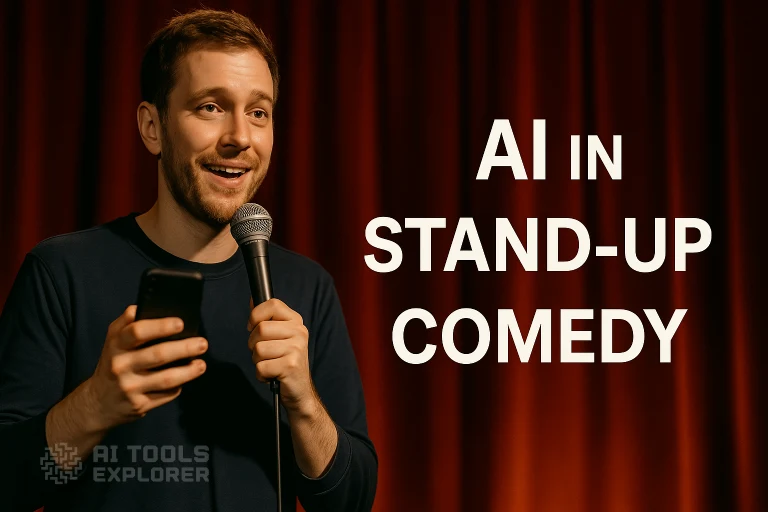
The club was half-empty, the kind of room where the lights feel too bright and the laughter never quite drowns out the sound of the bartender stacking glasses. Jason, a new comic with shaky confidence, walked on stage gripping his phone. He smiled nervously, adjusted the mic, and admitted what most comedians would hide:
“Some of these jokes were written by a robot. If they bomb, don’t blame me—blame the machine.”
It was the audience’s first brush with AI in stand-up comedy, and nobody knew if the machine would deliver laughs or awkward silence. A few chuckles scattered across the room. Curiosity replaced boredom. People leaned in. They weren’t just waiting for jokes anymore; they were waiting to see what artificial intelligence thought was funny.
Late Nights and Blank Pages
Comedy, at its core, is lonely work. A comic sits at a kitchen table with half a pot of coffee and a notebook, trying to turn life’s frustrations into punchlines. Most of the time, the page stays blank.
For some performers, AI in stand-up comedy isn’t a replacement for the grind, but a way to break through writer’s block before the first cup of coffee goes cold. ChatGPT, Claude, Grok—the names sound more like cartoon characters than creative partners, but they don’t complain, don’t sleep, and never run out of ideas.
Type in, “Give me five jokes about airport security,” and you’ll get five punchlines. Some are bad, some are worse, but one might spark a laugh. That’s enough. The comic rewrites it, adds their own story about losing toothpaste at TSA, and suddenly the machine’s clumsy line becomes stage-worthy.
It’s not stealing. It’s more like having a friend who throws spaghetti at the wall just so you can pick out the strands that stick.
The Bot That Booed Back
Maya, a Chicago comic, had a different problem. She could write jokes just fine, but crowd work—the unscripted banter with the audience—made her panic.
She trained with an AI model instead. She told it to act like a heckler. The screen lit up instantly:
- “You’re not funny, my grandma is funnier!”
- “Why’d you even come here?”
- “Is this the setup or the punchline?”
It stung, even though it came from a machine. But Maya fought back, line after line, until she got quicker on her feet. What started as a silly experiment showed Maya how AI in stand-up comedy could toughen her up before she ever faced a real heckler.
When a real drunk heckler interrupted her a week later, she was ready. The audience laughed, not just at the joke, but at the way she owned the moment. For her, the bot wasn’t a ghostwriter. It was a sparring partner.
Jokes Built for the Room
The dream of every comic is to feel like they’re speaking directly to the audience in front of them. AI makes that easier.
At a wedding, the best man can feed in details about the groom and get a tailor-made roast. At a company event, an emcee can punch up a dull introduction with a chatbot’s office humor. Even in comedy clubs, performers can swap out lines about New York traffic for ones about L.A. freeways with a few keystrokes.
The effect? The jokes feel alive, fresh, written for this night, this room, these people. And audiences notice.
When the Sidekick Steals the Show
One comic in Los Angeles took things further. Halfway through her set, she pulled out her phone and announced she was letting her chatbot write a joke live. She asked it for a line about Chicago pizza.
Through the speakers came a flat, robotic voice:
“Chicago deep dish isn’t pizza. It’s lasagna that lied on its résumé.”
The audience erupted. The comic laughed, shaking her head:
“Great. I’m being upstaged by my phone.”
The bot bombed just as often as it killed, but that was part of the fun. The real joke wasn’t only in the punchline – it was in watching a human and a machine try to share stage. These odd experiments highlight AI in stand-up comedy as more than a writing tool – it can be a performer in its own right.
From One Set to a Hundred Clips
In the old days, a set lived and died in the room. If you crushed, the laughs were gone by morning. If you bombed, the embarrassment faded too.
Now, comedy spills across platforms. Clips, memes, captions—everything becomes content. AI makes that easier.
After a show, a comedian can run their transcript through a chatbot. It spits out captions for TikTok, rewrites bits as tweets, even summarizes the set into a blog post. What was once one night’s performance becomes a week of online engagement.
In a world where comedians fight to be noticed in crowded feeds, that backstage help can be as important as the material itself.
Crossing Borders Without Losing the Punch
Humor is cultural. A joke that kills in New York might die in Tokyo. Wordplay doesn’t always translate, and cultural references can leave an audience confused.
But AI can reshape comedy for different audiences. A joke about Thanksgiving leftovers can turn into a joke about Lunar New Year feasts. A line about American football can become one about soccer.
For comedians dreaming of touring globally—or just connecting with fans online—this kind of adaptation could mean the difference between silence and applause.
The Temptation of Easy Laughs
Not every comedian is thrilled. Some worry that relying on AI makes them lazy. Why wrestle with a tough premise when you can get a dozen punchlines in seconds?
One comic tried it, performing a five-minute set written entirely by GPT. The audience chuckled, but the laughs felt thin, predictable. Afterward, another comic pulled him aside.
“The jokes worked,” he said. “But you didn’t. People come here for your voice. Don’t hand it over.”
It was a warning. AI can provide sparks, but if the fire doesn’t come from the performer, the audience feels it.
What AI Can’t Fake
At its best, stand-up isn’t just about words. It’s about timing—the pause before the punchline, the shift in tone, the shared silence that makes the laugh hit harder. It’s about vulnerability, about standing under hot lights with nothing but a microphone and the hope that strangers will laugh with you instead of at you.
AI doesn’t know stage fright. It doesn’t feel relief when the room finally breaks into laughter. It can mimic style, but it can’t mimic sweat.
That’s why AI won’t replace comedians. It can be a writing partner, a heckler simulator, even a strange new sidekick. But it can’t be the trembling human heart at the center of the performance.
Tomorrow’s Stage
Still, the future of comedy will be stranger than anything we’ve seen. Imagine a show where the audience shouts topics, an AI spits out jokes in real time, and the comic riffs off them. Imagine Netflix specials where viewers choose whether they want the punchline to be sarcastic, goofy, or dark. Imagine comedy duos where one half is human, the other half is a machine.
Comedy has survived every change: from smoky vaudeville halls to late-night TV to TikTok clips looping on our phones. AI is just the next twist.
The laugh, though—the laugh is still ours.
Final Bow
Back in that Los Angeles club, Jason finished his set with one last line, half his and half the bot’s. The crowd laughed, not because the joke was perfect, but because they felt like part of an experiment. They had witnesed comedy stumble into a new era.
Jason walked off stage sweaty, relieved, and grinning. For once, he didn’t feel alone. The machine might have helped write the words, but the laughter still belonged to him – and to the people who came to hear a human take the risk of being funny. In the end, AI in stand-up comedy doesn’t replace the performer; it pushes them to find new ways of owning the laugh.
