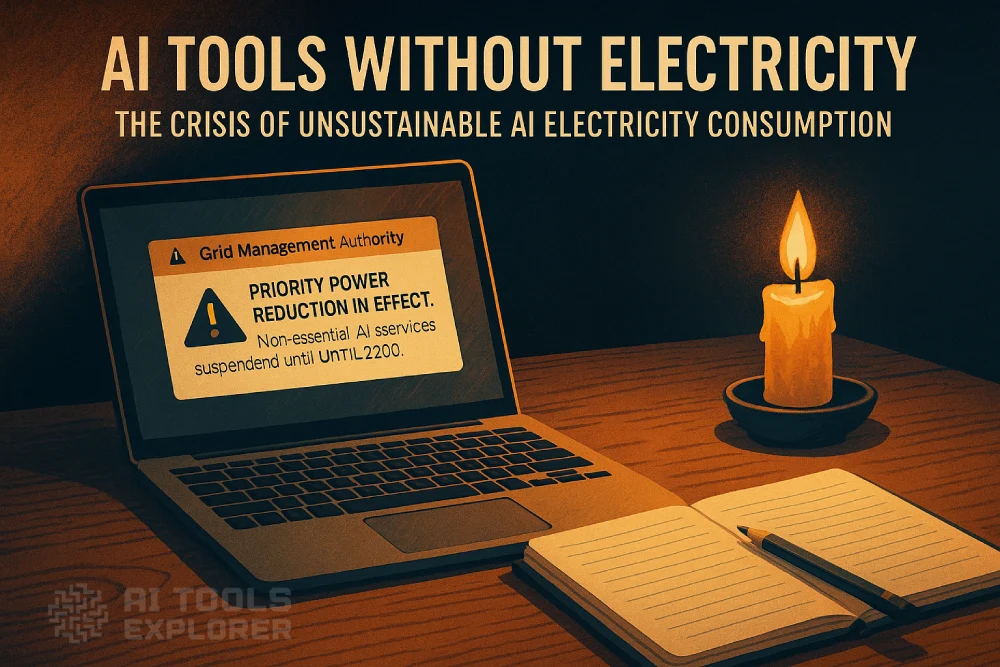
The notification appears on your screen, not from your AI assistant, but from the Grid Management Authority: “Priority Power Reduction in Effect. Non-essential AI services suspended until 22:00. Your query has been logged.” You stare, momentarily paralyzed. The email won’t draft itself. The presentation won’t generate. The world’s knowledge, once at your fingertips with a whisper, is now silent—not by a crash, but by calculated rationing. We are entering the age of AI tools without electricity, a future where our most advanced intelligence is shackled not by code, but by the desperate economics of the watt.
This is not a scene from a dystopian novel. It is a potential future we are silently engineering, one data center at a time. Welcome to the era of AI tools without electricity—not because they’ve evolved beyond it, but because we can no longer afford to give it to them.
What is AI Energy Consumption?
AI energy consumption refers to the vast amount of electrical power required to develop and run artificial intelligence systems. This includes the intense, concentrated energy used to train large algorithms on supercomputers and the continuous AI power usage of millions of servers delivering answers to everyday users. This collective electricity demand is a defining challenge of the modern digital economy.
The Insatiable Appetite: How AI Ate the Grid
The story begins with a simple, unexamined assumption: that power is infinite. Modern AI are computational beasts. The process of inference—every query you make—adds a constant, global drain. This skyrocketing AI electricity consumption from global data centers energy demand is pushing old infrastructure to its limits. Source: IEA – AI is set to drive surging electricity demand from data centres
Key Facts About AI and Electricity Use
- Training a single advanced AI model can consume more electricity than 100 US homes use in an entire year.
Source: Carbon Brief – AI: five charts that put data centre energy use into context - Data centers energy demand for AI could grow exponentially, with some projections suggesting it may double by 2026.
- The AI impact on power grids is systemic, requiring not just more energy, but more reliable, always-on baseload power that is often scarce.
Source: Reuters – Data centers could use 9% of U.S. electricity by 2030 - This consumption is driven by two phases: the initial training (a massive one-time cost) and the ongoing inference (millions of small, continuous costs).
How Much Power Are We Talking About?
To understand the scale, consider a comparison: The AI electricity consumption of a major tech company’s AI operations may soon surpass the total annual power usage of some small countries. One estimate suggests the AI sector could use as much electricity annually as the entire nation of Japan by 2030. This places an unprecedented burden on global generation capacity. Source: International Energy Agency (IEA); Carbon Brief
The Tipping Point: Will AI Cause Electricity Shortages?
Will AI cause electricity shortages? The risk is tangible, though not inevitable. It is less about a single global blackout and more about persistent regional scarcity, where AI power usage competes directly with human necessities. In areas with strained grids, electricity for AI may become rationed, prohibitively expensive, or intermittently unavailable, leading to a new form of digital divide based on energy access. History suggests progress is fragile — a lesson echoed during the AI Winter, when research stalled due to structural constraints.
Scenarios from a Low-Power World
- The Priority Grid: Governments implement “Compute Tiers.” During peak demand, AI tools are the first to be starved of power. Your smart home reverts to being just… a home.
- The AI Energy Gap: A new digital divide emerges. Tech giants with their own power sources become superpowers. Startups and smaller nations are priced or powered out of the race.
- The Return of the Analog Buffer: People keep paper notebooks because the cloud is unreliable. Skills we atrophied in the name of efficiency come rushing back from necessity – a concern also explored in Does AI Make You Dumber?
The Irony and the Opportunity
The supreme irony is that we are using AI to optimize power grids while simultaneously choking them. This AI impact on power grids forces a new wave of innovation:
- The Rise of Ultra-Efficient Hardware: The race is on for the 1-watt wonder chip.
- Algorithmic Austerity: Quality is measured in accuracy-per-joule.
- The Distributed Intelligence Revolution: Intelligence moves to the edge, to your phone or watch, reducing central data centers energy demand.
- The Green AI Mandate: “Powered by 100% off-grid solar” becomes the most coveted marketing tag.
Conclusion: Navigating the New Energy Reality
The central challenge of the coming decade is managing AI energy consumption against finite global capacity. The discourse must move beyond raw capability to sustainable integration, weighing every advance in artificial intelligence against its tangible AI electricity consumption. The future of AI depends not just on smarter algorithms, but on a smarter, more resilient relationship with the power that sustains it. The path forward requires balancing unprecedented innovation with fundamental resource constraints, ensuring that the tools designed to empower humanity do not inadvertently dim the lights on our collective future.
