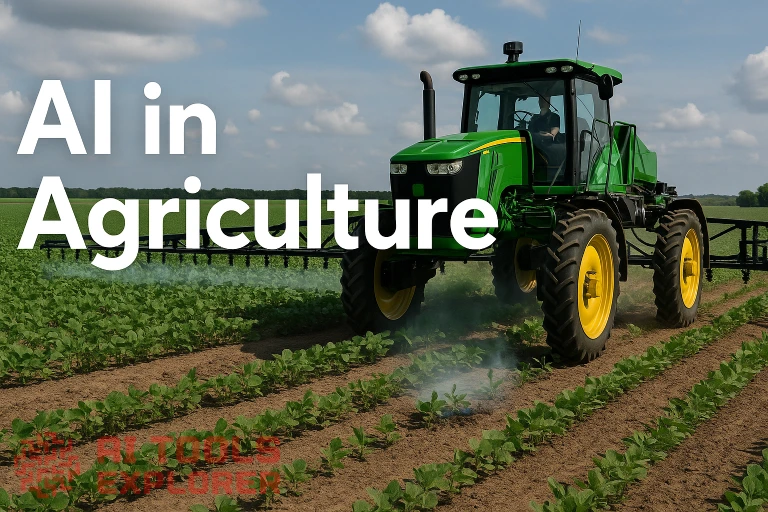
Mark is a soybean farmer in Arkansas. For years, he sprayed every acre of his fields with herbicides, even though he knew much of it was wasted. In 2024 he tried something new: a sprayer guided by cameras and software that could spot weeds in real time. Powered by AI in agriculture, the machine sprayed only the weeds, not the whole field.
At the end of the season, Mark’s bills for chemicals were nearly cut in half. His crop yields stayed the same. That was when he realized AI wasn’t just something for tech companies – it could help farmers too.
What AI in Agriculture Means
When people talk about AI in agriculture, they don’t mean robots replacing farmers. It’s about using software that can “see,” “listen,” or “predict,” then guide a tool or machine.
- Cameras on tractors spot weeds.
- Apps on phones check for crop disease.
- Sensors in soil decide when to water.
- Satellites watch fields from above.
The farmer is still in charge. AI just helps with the heavy thinking.
Less Spray, Same Yields
Spraying weeds is one of the most costly and time-consuming jobs in farming. New smart sprayers use cameras and computer vision to tell weeds from crops.
Field trials with John Deere’s See & Spray showed a 28–62% drop in herbicide use without cutting yields. In a three-year study, the savings were 43–59% overall.
[Source: Arkansas Agricultural Experiment Station]
For farmers, that means less money spent and less chemical exposure. For the land, it means less runoff into rivers and soil.
Lasers Instead of Chemicals
Another new method looks like something from a science fiction movie. Robots now roll through vegetable fields firing tiny lasers at weeds.
Tests with Carbon Robotics’ laser unit in 2024 showed 97% weed control in beets, spinach, and peas. Some crops even grew 30% larger compared with sprayed plots.
[Source: National Library of Medicine]
For organic growers, this could be a real alternative to herbicides. One farmer said it felt like “magic” to watch weeds vanish without touching the crop.
Saving Water With Smarter Pumps
Water is precious, especially in dry regions. Farmers often guess when to turn on pumps, but AI can make better choices.
Machine-learning irrigation systems track soil data and weather. In studies, they saved 20–27% of water while also cutting electricity costs.
[Source: Computers and Electronics in Agriculture]
In vineyards in Spain, growers say the system “knows when the vines are thirsty” and prevents over-watering.
Checking Crops With a Phone
In Africa, cassava farmers often lose crops because they can’t spot disease early enough. Extension workers may be hours away, and local knowledge has limits.
The PlantVillage Nuru app puts AI into a smartphone. By pointing the camera at a leaf, farmers get a diagnosis. In tests, the app was right 65% of the time, better than trained agents (40–58%) and far better than farmers alone (18–31%).
It’s not perfect, but it’s better than guessing – and it fits in a farmer’s pocket.
From Tomatoes to Corn: AI Helps Farmers Catch Problems Early
Imagine a tomato farmer in Kenya walking her rows early in the morning. She notices curled leaves on several plants but isn’t sure if it’s drought stress or something worse. She pulls out her phone, snaps a photo, and the app flags tomato leaf curl virus. Instead of waiting weeks for an agronomist, she can isolate those plants and save the rest of her crop.
In Iowa, a corn grower uses the same kind of AI tool after spotting strange black specks on leaves. Within seconds the phone suggests tar spot corn, a disease that has spread fast in the Midwest. With an early warning, he can plan treatment before the outbreak reduces his yields.
Another farmer in India points his camera at yellowing tomato leaves. The app suggests two possible issues: calcium deficiency in tomatoes or early-stage blight. To confirm, the farmer checks again two days later and sees signs of infection. He gets a recommendation for a tomato blight fungicide, buys the product locally, and stops the disease before it spreads.
Even seed choices can be guided by AI feedback. A grower who has fought tomato diseases for years asks the app for advice and receives a list of tomato resistant varieties suited for her region. Instead of trial and error, she has options tailored to her climate and soil.
These are the kinds of small, everyday moments where AI doesn’t replace a farmer’s judgment but adds a layer of quick, reliable support.
Watching From the Sky
AI doesn’t just live in tractors or phones. Satellites now help governments check if farmers follow subsidy rules.
In the EU, the Area Monitoring System uses images from space and AI software to monitor millions of acres at once. It cuts paperwork and gives near real-time updates on what’s planted where.
Healthier Herds With AI
Dairy farms are using cameras and sensors to watch cows as they eat, rest, and move. AI systems can tell one cow from another with 97% accuracy.
This helps farmers spot sick animals faster and keep herds healthier. It also saves time—less walking the barn, more acting on alerts.
Tractors That Drive Themselves
John Deere has been showing off tractors that don’t need drivers. These machines use cameras and AI chips to guide themselves through fields.
The company says orders will open soon. For large farms, self-driving tractors could solve labor shortages. For smaller farms, price remains a big question.
What Farmers Are Seeing
Real field results show the impact of AI in agriculture:
- Herbicide use cut by half in soybeans.
- 97% weed removal with lasers.
- 20–27% water savings with smart irrigation.
- Better disease spotting than humans using phone apps.
These are not lab results—they come from actual farms.
Roadblocks Ahead
The technology is promising, but not every farmer can use it yet.
- Costs are high. A laser robot can cost as much as a new pickup truck.
- Internet is patchy. Many rural areas lack the data connections AI needs but Elon Musk’s Starlink saves the day.
- Data ownership is unclear. Farmers worry who controls the data collected on their land.
- New rules are coming. In Europe, the AI Act sets deadlines for transparency and safety. Even “low-risk” farm AI must comply by 2026.
What’s Next
Looking at 2025, three shifts stand out:
- Targeted sprayers and laser weeders will move from test fields into wider use.
- Autonomous tractors will leave demo shows and enter actual farms.
- Satellite-based compliance checks will become normal in the EU.
In short, AI in agriculture is stepping out of the trial stage and into daily farm work.
Final Thought
Farming has always changed with technology—from horse-drawn plows to GPS tractors. Now AI is the next step. It won’t replace farmers, but it will give them sharper tools: sprayers that see, pumps that predict, and apps that diagnose.
The soil still feeds the crop, the sun still drives growth, and rain still decides fortunes. But in 2025, lines of code are joining that list.
