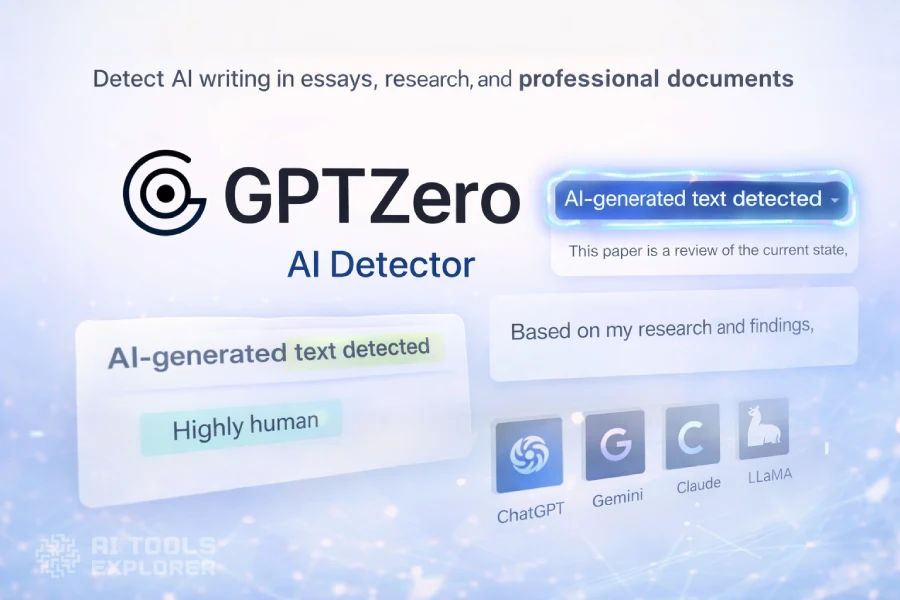
What is GPTZero?
GPTZero is an AI detector that checks written text to find out whether a large language model wrote it. As AI writing gets harder to spot, a simple yes-or-no result doesn’t tell you much. GPTZero highlights the specific sentences it flags, explains what triggered the classification, and rates how confident it is in the result. It covers output from models including ChatGPT, Gemini, Claude, Llama, and Deepseek.
The tool does more than run an AI detector scan. It can check for plagiarism, spot hallucinations in AI-generated text, analyze how a document was written over time, and push structured feedback into Google Docs. Teachers, editors, recruiters, and researchers may all have reasons to verify whether a piece of writing is genuinely human.
GPTZero Video
Features & Benefits
- Sentence-Level AI Detection: scan text and get color-coded highlights showing which sentences are likely AI-generated, plus an overall AI percentage for the document.
- Three-Class Classification: return one of three verdicts: human-only, AI-only, or a mix of human and AI writing.
- Confidence Ratings: each AI detector result includes a confidence level (low, medium, or high); the “high” rating carries an error rate below 1%.
- Advanced Scan: run a deeper pass that shows which writing patterns pushed the classification toward AI.
- Paraphraser Shield: catch AI content that has been paraphrased or altered with homoglyph character swaps to avoid detection.
- Multi-Model Coverage: detect AI writing from models across OpenAI, Google, Meta, Anthropic, and others.
- Hallucination Detector: flag factual inaccuracies that large language models may have introduced into a text.
- Plagiarism Checker: check whether content was lifted from external sources without attribution.
- Writing Report for Google Docs: see a full edit history, typing pattern analysis, copy-paste activity, and a video replay of how a document was written; export the report as a PDF.
- AI Writing Feedback: send feedback comments directly into Google Docs, with the option to upload a rubric or assignment for more specific suggestions.
- Grammar and Writing Checker: get AI-powered suggestions to improve writing quality.
- Chrome Extension: run an AI detector scan on any webpage or Google Doc from the browser.
- Bulk File Upload: upload .docx, .pdf, or image files and scan up to 50 at once.
- Multi-Language Support: detect AI-generated content in English, German, Portuguese, French, and Spanish.
- ESL De-biasing: a model component trained to cut false positives for non-native English writers.
- Integrations: connect with learning management systems and workflow automation tools, including classroom management platforms.
- API Access: scan text programmatically and get sentence-level results back; submitted documents are not stored.
- Shareable Reports: send results as a direct link or download them as a PDF.
What can GPTZero do?
- Detect AI-generated text in an essay
- Check if an assignment was written by ChatGPT
- Identify mixed human and AI writing
- Scan a document for AI content sentence by sentence
- Verify the authenticity of submitted writing
- Check for plagiarism in student work
- Detect paraphrased AI content
- Flag hallucinations in AI-generated text
- Replay a document’s writing history
- Analyze typing patterns in a Google Doc
- Give writing feedback on an essay
- Check grammar and writing quality
- Scan a webpage for AI-generated content
- Detect AI writing in multiple languages
Real-World Applications
Teachers reviewing written assignments may want more than an overall score. The sentence-level highlights and confidence ratings point to specific passages, which makes it easier to talk through a flagged submission with a student rather than relying on a vague verdict.
Hiring teams often receive cover letters and writing samples that look polished but don’t reflect much original thought. Running submissions through an AI detector can reveal whether the writing is the candidate’s own before moving them further along in the process.
A fact-checker at a publication dealing with outside contributors might care less about whether a piece used AI and more about whether it’s accurate. The hallucination detector can flag made-up citations or introduced inaccuracies, which are far easier to catch before something goes to print.
The API makes GPTZero practical for processing large document sets programmatically. Researchers tracking how AI writing appears in academic publishing or legal filings can pull sentence-level classifications and confidence scores directly from the API, with no submitted content stored on GPTZero’s end.
Students who want to improve their own writing can use the feedback and grammar tools without any detection purpose in mind. The Writing Report’s replay shows a full edit history of a Google Doc, which can surface habits like heavy copy-pasting or large chunks written in a single burst.